
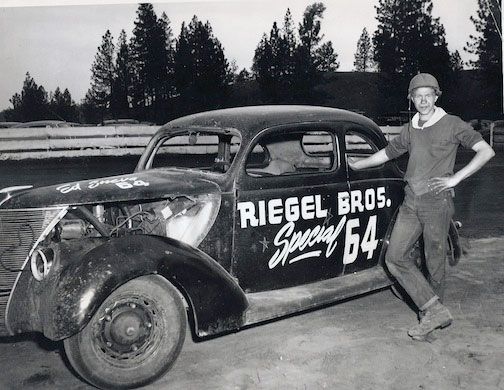
STATELINE — The 11th annual Ed Sneva Memorial race returns to Stateline Speedway
For a 2 day event, June 30 and 31 as a tribute to the patriarch of Spokane’s long-time family of speed.
The race will be true to the Sneva tradition of open-wheel racing with a reported field of 30 Can-Am Sprints, 25 wing cars and possibly 20 midgets chasing a combined $25,000 purse. Visit Raceidaho.com for more information.
One of the organizers is TJ Sneva, natural a sprint car driver, Edsol’s grandson and son of the late Jerry Sneva.
TJ represents the third of what will soon be four generations of the Sneva’s in racing. and plans on getting his kids into racing soon.
“Grandpa was awesome always trying to make his cars faster,” TJ wrote in an email. “I remember my uncle Blaine winning at Ephrata getting home at 3 in the morning and as soon as I feel asleep he woke me up saying he couldn’t sleep and was heading to the shop.”
TJ raced for 10 years in Indianapolis with his dad. “It was super fun having him with me in my pit. I think he had more fun with me than he did with his own racing.”
First organized in 2015, the event honors Edsol Sneva who began racing both locally and regionally in the 1950s.
Edsol “Ed” Sneva died in 2014, but “Dad was not the funeral kind of guy so having a race like this is what he would have wanted,” his youngest son, Blaine Sneva once said.
“He built a family dynasty of race car drivers, it was amazing,” said Norm Ellefson who drove against Tom Sneva many times in the 1960s and 1970s.
Three of the boy’s, Tom, Jerry and Jan all have driven on the sacred ground of the Indianapolis Motor Speedway. Tom earned his place in motorsports history winning the coveted race in 1983, helping pave his road to induction into the Motorsports Hall of Fame of America in Detroit.
In a comparison best illustrated by football, what Edsol Sneva accomplished might compare him in some respects to racing’s version of Archie Manning whose sons, Payton and Eli, have accomplished amazing things on the football field.
Edsol moved to Spokane and finished his formal “book learning” in 1948, graduating from Lewis and Clark High School. There he was a standout athlete, a four year letterman in football, basketball and track.
He met Joan Giles and they graduated together. They were married Feb. 26, 1948 and made Spokane their home. Ed and Joan had six children, five boys and one girl.
Ed began his love of racing cars in 1950, first at Mead Speedway, then Wednesday nights at Memorial Stadium, better known now as Albi Stadium.
“The first day out he made a clean sweep,” Joan Sneva said in a 1973 Spokane Daily Chronicle story of Ed’s debut on the dirt track at Mead .
“I just knew he’d make a big fool of himself, and I remember saying that to him, too,” said in a 1973 Spokane Daily Chronicle story. “I just couldn’t believe it (the sweep). I didn’t think he knew what he was doing in the first place, but he sure did.”
Joan Sneva, who passed away in 2017, also remembered in that story how Ed started racing before he was the legal age of 21. He had newspaper delivery routes to pay for his racing habit.
Ed dominated racing in the Inland Northwest as a driver. At one point the other drivers coerced the promoter to buy Ed’s winning car and cut it up. But his sponsor, the city of Ritzville, just built him another car and it kept on winning.
When he finished racing, Ed started an automobile repair business in Spokane and a race car shop in the basement. When they were old enough, Ed passed along his love for racing to his sons.
Tom was the first one to enjoy Ed’s innovations. Ed built the first rear engine short track car, which Tom raced locally and against the Canadian American Modified Racing Association (CAMRA) teams.
With the success of that rear-engine, low-budget car, and Ed being an innovator, he came up with an idea and approached friend and racecar builder Jim Tipke.
He wanted Tipke to build the most radical short track race car ever for Tom to drive. It would be a rear engine, offset, 4 wheel drive car that dominated CAMRA right out of the shop. The competitors wanted the car banned. Tom easily won the 1970 CAMRA championship, helping to launch his IndyCar career.
Sneva had no formal mechanical training, just a natural God given ability for what he did. His ability was natural, Blaine Sneva said. “Why have something that someone else has if you can make it.”
As for Sneva and Tipke, among others, “(They) didn’t know they can’t do things, so they just go ahead and do them,” added Ellefson, a member of the Canadian Motorsports Hall of Fame.